SMS Pumping Detection
Prevent Toll Fraud & Artificial SMS Traffic with Real-Time Detection
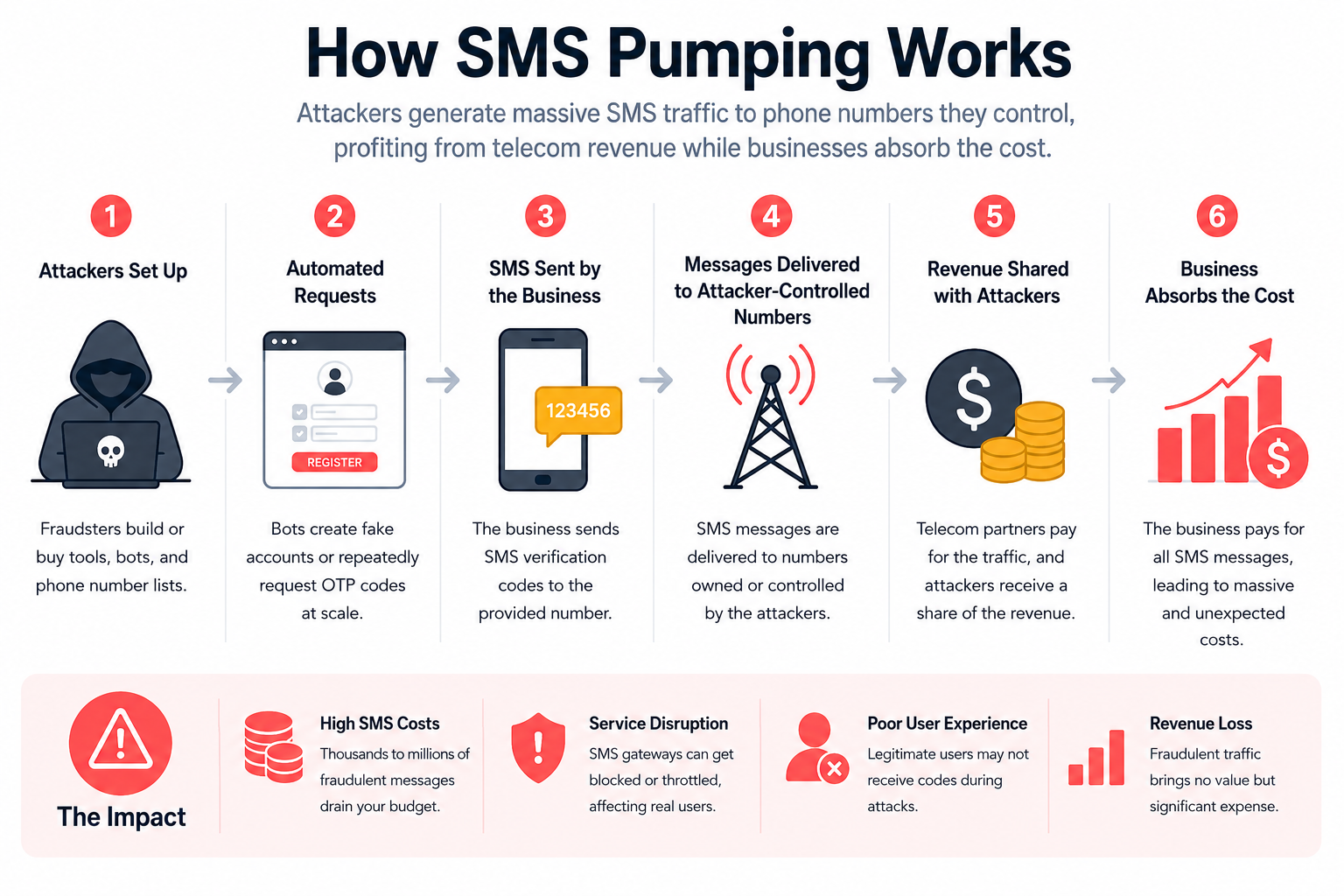
What is SMS Pumping Fraud?
SMS Pumping, also known as International Revenue Share Fraud (IRSF), is a growing form of telecom fraud where malicious actors exploit SMS verification endpoints by generating massive volumes of one-time password (OTP) or 2FA requests to high-cost, premium rate numbers. The goal is to drive artificially inflated SMS messaging traffic and generate revenue via interconnection fees shared with telecom operators or fraudulent aggregators.
Businesses using SMS-based two-factor authentication (2FA) or account creation flows are prime targets, especially when attackers automate fake sign-ups, free trials, logins, or password resets across international number ranges.
How IPQualityScore Prevents SMS Pumping Attacks
IPQS leverages advanced telecom metadata, behavioral analytics, velocity and usage patterns, device fingerprinting technology, and real-time traffic scoring to detect and block suspicious SMS traffic before any messages are sent. By analyzing the risk factors associated with a phone number, IPQS can accurately flag:
- High-cost international premium rate numbers
- Fake phone numbers generated by bots or VoIP services
- Unusual volumes of SMS requests from single IPs or devices
- Carrier reputation, number validity, and routing anomalies
- Known fraud rings and abusive number patterns
- Unusual velocity patterns consistent with SMS pumping attacks
These real-time insights enable businesses to block risky phone numbers, throttle suspicious traffic, or apply stricter user verification flows based on phone number quality score thresholds.
Enterprise-Grade Protection Against Toll Fraud
Our SMS Pumping Detection API integrates seamlessly with existing sign-up forms, 2FA flows, and messaging systems. Designed to scale with large enterprise environments, IPQS provides sub-50ms API response times, global telecom data coverage, and dynamic rule sets customized to your platform's abuse patterns.
Empower your fraud team with detailed insights such as:
- Real-time SMS risk score (0-100)
- Number validity and reachability
- Carrier name and country of origin
- Is the number linked to SMS pumping or toll fraud?
- Device behavior and velocity scoring
- Identity enrichment and user activity signals
These real-time insights enable businesses to block risky phone numbers, throttle suspicious traffic, or apply stricter user verification flows based on phone number quality score thresholds.
All results are enriched by IPQS' proprietary threat intelligence network, including honeypot traps, telecom reputation feeds, and AI-powered anomaly detection.
Global Coverage & Real-Time SMS Fraud Intelligence
IPQS maintains one of the world's most accurate SMS threat detection networks with global telecom carrier monitoring, traffic analysis, phone number abuse reports, and real-time detection of fraudulent number ranges. Access real-time phone number intelligence signals with 100% match rates for any mobile network operator or country. Whether you're a messaging provider, fintech company, consumer service, or SaaS platform, our coverage includes:
- All 195 countries and territories
- All major telecom operators and MVNOs
- VoIP & disposable number detection
- Real-time blocklist of abusive number prefixes
- Automated abuse reporting and alerting tools
Stop Losing Revenue to SMS Pumping Fraud
Protect your platform from fraudulent SMS traffic and inflated carrier charges. IPQS makes it easy to identify and prevent toll fraud before it costs your business.
SMS Pumping Detection vs. Phone Validation
Phone validation and SMS pumping detection are complementary technologies, but they solve different problems. A phone validation service verifies that a phone number is properly formatted, active, and capable of receiving SMS messages. This helps reduce delivery failures and improves the accuracy of customer data.
SMS pumping detection goes a step further by determining whether a verification request is legitimate or part of a coordinated fraud campaign. Even a valid phone number can be used in an SMS pumping attack if fraudsters repeatedly trigger verification messages for financial gain. Simply confirming that a phone number exists does not identify abusive behavior.
Effective SMS pumping prevention requires analyzing multiple fraud signals beyond the phone number itself. By evaluating IP reputation, device fingerprinting, proxy and VPN usage, behavioral patterns, traffic velocity, carrier intelligence, and historical abuse data, organizations can distinguish legitimate verification requests from automated attacks before an SMS is sent.
For the strongest protection, businesses should combine phone validation with real-time SMS pumping detection. Together, these technologies improve message deliverability, reduce unnecessary SMS costs, prevent toll fraud, and provide a seamless experience for legitimate users while blocking abusive traffic.
How SMS Pumping Attacks Work
Most SMS pumping attacks target account registration, login verification, password recovery, and multi-factor authentication workflows that automatically send one-time passcodes (OTPs) by text message. Fraudsters use automated tools to generate large volumes of verification requests, causing businesses to send SMS messages to phone numbers associated with the attack.
The goal is not necessarily to gain access to accounts. Instead, attackers attempt to generate as much SMS traffic as possible through specific carriers, number ranges, or telecom partners that provide financial incentives for message delivery. As traffic volume increases, messaging costs rise for the targeted organization while fraudsters profit from the artificially generated activity.
These attacks are often distributed across thousands of IP addresses, devices, and phone numbers to avoid detection. By spreading requests across multiple sources, attackers can bypass basic rate limits and create traffic patterns that resemble legitimate user activity.
Without real-time fraud detection, organizations may not discover an attack until messaging costs spike or verification systems become overloaded. Detecting suspicious phone numbers, devices, networks, and traffic patterns before an SMS is sent is one of the most effective ways to stop SMS pumping fraud.
The Cost of SMS Pumping Fraud
SMS pumping attacks can generate significant financial losses in a matter of hours. Because businesses pay for every verification message sent, attackers can rapidly inflate messaging costs by triggering thousands or even millions of fraudulent SMS requests. Many organizations do not discover an attack until they notice a sudden spike in SMS spending or receive an unexpectedly large bill from their messaging provider.
Direct messaging costs are only part of the problem. Large-scale attacks can overwhelm verification systems, consume operational resources, increase customer support workloads, and disrupt legitimate user registrations. In severe cases, SMS providers may throttle or restrict traffic, creating additional friction for real customers attempting to access accounts or complete transactions.
Organizations that rely heavily on one-time passcodes (OTPs), multi-factor authentication (MFA), and phone verification workflows are particularly vulnerable because these systems automatically generate SMS messages in response to user activity. Without real-time fraud detection, attackers can exploit these processes at scale while blending in with legitimate traffic.
Preventing SMS pumping before messages are sent is the most effective way to reduce fraud losses, protect messaging budgets, and maintain a reliable user experience.
Early Warning Signs of an SMS Pumping Attack
SMS pumping attacks often begin gradually before escalating into large-scale fraud. Recognizing suspicious traffic patterns early can help organizations stop abuse before messaging costs spike and verification systems become overwhelmed.
One of the most common warning signs is a sudden increase in SMS verification requests that does not correspond with normal user growth. Businesses may also notice unusually low account registration completion rates, indicating that verification messages are being requested without any genuine intent to create or use an account.
Geographic and carrier anomalies can provide additional indicators of abuse. A large percentage of verification requests originating from a small group of countries, carriers, or phone number ranges may signal an SMS pumping campaign. Similar patterns can emerge when attackers repeatedly target specific destinations that offer favorable telecom revenue-sharing arrangements.
Technical signals are equally important. High volumes of requests from residential proxies, VPNs, emulators, automated devices, or rapidly changing IP addresses often indicate attempts to bypass traditional rate limits and fraud controls.
Monitoring phone intelligence, device behavior, network reputation, and traffic velocity together allows businesses to identify SMS pumping attacks earlier and prevent fraudulent messages from being sent.
Why Traditional SMS Fraud Controls Fail
Many organizations assume that basic security controls such as rate limiting, CAPTCHAs, or IP blocking are enough to prevent SMS pumping attacks. Unfortunately, modern fraud operations are specifically designed to bypass these defenses. Today's attackers use distributed botnets, residential proxy networks, device emulators, and thousands of legitimate-looking phone numbers to spread SMS requests across countless identities, making malicious traffic appear like normal user activity.
A simple rule such as "block users after five verification attempts" rarely stops professional fraud groups. Instead of generating hundreds of requests from one IP address, attackers generate one or two requests from thousands of unique IPs, devices, and phone numbers. From the perspective of a traditional firewall or rate limiter, every request appears completely legitimate.
SMS pumping attacks also exploit trusted parts of the verification process. The phone numbers themselves are often valid, the requests originate from real mobile devices or residential internet connections, and the behavior closely mimics genuine account registrations. This makes it difficult for conventional fraud prevention systems to distinguish legitimate customers from coordinated abuse.
- Distributed botnets bypass IP-based rate limits.
- Residential proxies make malicious traffic appear trustworthy.
- CAPTCHAs are solved using automation or human-solving services.
- Device emulators continuously generate new device identities.
- Valid phone numbers hide fraudulent verification requests.
- Low-volume attacks spread across thousands of users evade traditional velocity thresholds.
Effective SMS pumping prevention requires much more than counting requests. By analyzing IP reputation, device fingerprinting, phone intelligence, behavioral analytics, carrier data, and historical abuse patterns together, organizations can identify coordinated fraud before an SMS message is sent. This layered approach provides significantly better protection against sophisticated SMS pumping campaigns while minimizing false positives for legitimate users.
Monitor SMS Volume & Identify SMS Velocity Anomalies
IPQS leverages advanced machine learning algorithms to detect suspicious SMS patterns and artificial messaging traffic in real time. We designed our system to automatically mitigate SMS toll fraud, commonly known as SMS pumping, during critical workflows such as account creation, multi-factor authentication (MFA), and identity verification. By intelligently analyzing velocity metrics and telecom metadata, including carrier information, geographic origin, user identity, and behavioral trends, IPQS significantly reduces the financial impact of these attacks on your business.
Use Cases for SMS Pumping Detection
- Lead Generation: Filter out fake leads that submit SMS-verified forms.
- User Sign-Ups: Prevent fake users from using costly or fraudulent numbers.
- 2FA & OTP Flows: Stop bots from abusing free SMS verification requests.
- Messaging Platforms: Monitor carrier destinations for risk and fraud patterns.
- Financial Services: Ensure secure multi-factor authentication via SMS.
Phone Number Risk Scoring
In addition to detecting SMS pumping, IPQS also provides real-time telecom risk intelligence to detect fraudulent phone numbers, abusive users, and even bot registrations using prepaid, virtual, and disposable phone numbers. Phone number risk attributes paired with activity, identity, and validation data enhance user quality controls and make it easy to identify fraudulent accounts.
Simple API Integration with Custom Rules
Add SMS pumping protection in minutes with our easy-to-implement RESTful API. IPQS provides developer-friendly documentation, SDKs in popular languages, and real-time monitoring to block abuse attempts and fraud schemes at the source.
Want tailored rules? Our enterprise clients receive custom thresholds, dedicated fraud analysts, and white-glove onboarding support to optimize fraud detection for your specific use case.